Business accounts statistics
Page content:
What is your data used for?
Companies in the non-agricultural private sector report detailed financial data on their profit/loss, balance and this year’s investments etc. - data that cannot be obtained from the Danish Tax Agency or the Danish Business Authority. Your reporting is therefore necessary in order to illustrate the economic situation and the development in the business sector. The statistics are used in Denmark and the EU for analyses, political decisions, regulations, support schemes, and are included in the Danish national accounts. The statistics are also used by industry organisations, such as the Danish Industry. See the latest news from the statistics at the bottom of the page (in Danish).
Key figures from the statistics
Start the survey
You can report in two different ways:
A. Report via Statistics Denmark's online form
- Choose "Start reporting" below.
- Select "Indberet for [period]", enter your data and submit.
B. Report XBRL format with Statistics Denmark's taxonomy - via virk.dk
- Create your XBRL file.
- Select "Go to "Regnskab - Special" below - you will be redirected to virk.dk.
- Upload the XBRL file.
Read more under Guidance, preparation and questionnaire draft below.
If you want your accountant/auditor to report on your behalf, you must first create a business power of attorney. Read about the agreement here: Create a business power of attorney, if your accountant/auditor reports on your behalf.
Guidance, preparation and draft
Overview of the survey questions
You can download an overview of all the questions in the survey below - as a draft or as part of preparation for your report.
Please note, that some items in the online form can be pre-filled with relevant information from the company's annual financial report, previously submitted to the Danish Business Authority. Items that may be pre-filled are marked in the draft.
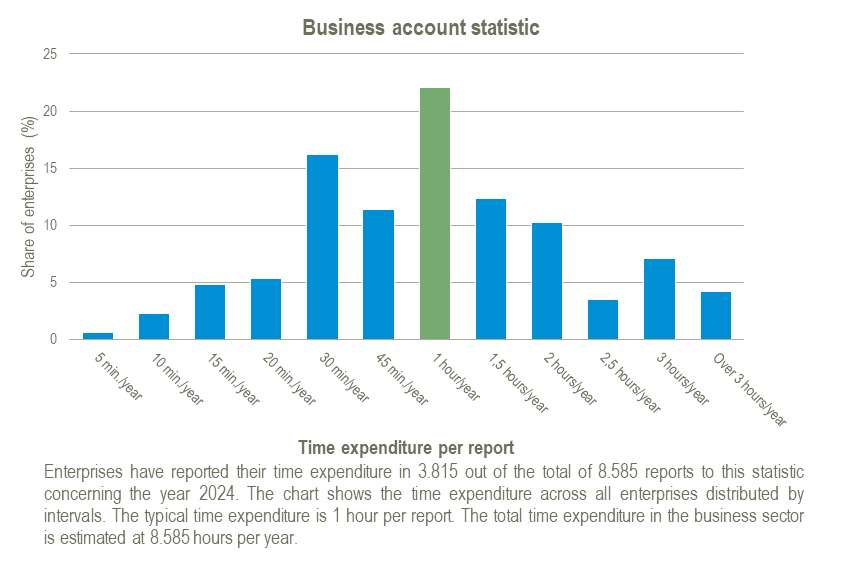
Typical time spent per report is approximately 1 hour.
See all of the questions: Business accounts statistics (PDF - draft)
Your report must always contain:
- The profit and loss statement (items no. 1-19), such as revenue, purchases of goods (materials), external labour/cost of subcontractors, rent and operational leasing. This data is usually found in the specifications to either the internal annual financial report or the annual tax report.
- Balance sheet items, which can be found in the annual financial report.
- Investments for the year, which can usually be found in the annual financial report, the internal annual financial report or the annual tax report.
Parent companies
If your company is a parent company, you should only report data for the parent company – not consolidated financial data and not for the entire group.
Staggered financial year
Companies with a staggered financial year must report for the financial year that has ended between 1 May 2025 and 30 April 2026. Read more under "Deadlines".
The new classification of economic activities concerning Danish companies - Dansk Branchekode 2025 (DB25) - became effective as of 1 January 2025. At Statistics Denmark, the new DB25 classifications will be gradually implemented in the data collection processes for all our business statistics over the course of the year 2026.
The new classification contains a new definition of factoryless goods production. This definition does not affect reporting to the "ordinary" Business accounts statistics, but does affect reporting to Business accounts statistics - large corporations.
- How do you prepare your report?
- Can multiple employees contribute to a report?
- Is it possible to see previously submitted reports?
- Can you fill out the pages of the report in the order of your choice?
- Is data for the annual financial report submitted to the Danish Business Authority reused?
- Is it possible for an accountant or another third party to report on behalf of the company with a power of attorney?
A. Report via Statistics Denmark's online form
Some items in the online form may be pre-filled with relevant data from your annual financial report previously submitted to the Danish Business Authority. Read more here: Is data for the annual financial report submitted to the Danish Business Authority reused?
- Choose "Start reporting" below.
- Select "Indberet for [period]", enter your data and submit.
See all of the questions: Business accounts statistics (PDF - draft)
Power of attorney
If you want your accountant/auditor to report on your behalf, you must first create a business power of attorney. Read about the agreement here: Create a business power of attorney, if your accountant/auditor reports on your behalf.
Information security and data confidentiality
Is data for the annual financial report submitted to the Danish Business Authority reused?
B. Report XBRL format with Statistics Denmark's taxonomy - via virk.dk
All companies can report Business accounts statistics in XBRL format. It is important to use Statistics Denmark's taxonomy, which contains more data than the annual financial report to the Danish Business Authority. The XBRL file can be created either via accounting software or by using the template below.
Download the XBRL template with Statistics Denmark’s taxonomy (also includes instructions)
- Create the XBRL file (if using the template follow the instructions in the file).
- Select "Go to "Regnskab - Special" below - you will be redirected to virk.dk.
- Log in with MitID.
- Select ”Regnskabsstatistik til Danmarks Statistik”.
- Upload the XBRL file.
- Select "Indberet Regnskab".
- Check whether you have received a receipt confirmation for your report.
Information security and data confidentiality
Deadlines
| Period | Deadline |
|---|---|
| Året 2025 | 1. April 2026 |
| Period | Deadline |
|---|---|
| Året 2025 | 6. July 2026 |
| Period | Deadline |
|---|---|
| Året 2025 | 6. July 2026 |
| Period | Deadline |
|---|---|
| Året 2025 | 2. November 2026 |
| Period | Deadline |
|---|---|
| Året 2025 | 6. July 2026 |
Frequently asked questions
Reporting is mandatory by law.
Due to EU legislation, Denmark is required to produce a range of business statistics.
Act on Statistics Denmark, Section 8-12a obliges companies to report data for statistical use.
The number of companies required to report
Approximately 9,000 companies are required to report every year.
How are the companies selected?
These statistics include companies in the non-agricultural private sector. The statistics do not include agriculture, fishing, financial institutions, insurance, social housing, public administration etc.
Large companies: Companies with 50 or more employees (full-time equivalents) - as well as companies with an annual revenue (incl. VAT) of DKK 200 million or higher - are always included in the sample.
Small companies: A representative sample is selected among companies with 0–49 employees (full-time equivalents). The selected companies are required to report for a minimum of two years. This may be followed by a break, depending on the company's industry and size.
Companies can voluntarily state their time spent the online form. Companies typically spend approximately 1 hour on this report – including getting access, data retrieval, data entry, and, in some cases, contacting our support. Based on the typical time spent per report, the total time spent by the business sector is estimated at 8.585 hours per year.